On this page
- Define the comparison before collecting answers
- Use the same fields for every question
- Compare location context consistently
- Compare condition using the actual inspection scope
- Compare insurance proposals on matching terms
- Compare ownership costs beyond the monthly payment
- Include records and intended-use questions
- Use a compact worksheet in plain language
- A hypothetical comparison shows the value
- Avoid false precision in scoring
- Close the review with an action list
- Reusable comparison worksheet
- Sources and reference material
Two homes can have similar asking prices and very different ownership questions. One may come with detailed roof records and unclear drainage history. Another may have recent inspection information but incomplete documentation for an addition. A useful comparison makes those differences visible before you decide which home fits your plans.
The goal is not to invent a single score that declares a winner. It is to compare the same questions using the evidence available for each property. A structured worksheet helps you see confirmed facts, estimates, and unknowns without letting a polished listing fill the gaps.
Start with HC’s guide to researching hazards before buying. Then build the worksheet described here alongside your real estate, inspection, insurance, and other transaction work.
Define the comparison before collecting answers
Write down the two properties and the decision you need to make. Include your intended use, planned changes, budget constraints, and purchase deadlines. A home that works for immediate occupancy may raise different questions if you plan an addition, rental use, workshop, or other change.
Choose comparison categories that matter to both properties. Keep location context, physical condition, records, insurance, ownership costs, and intended-use questions separate. The categories should organize your research rather than imply that every issue has the same importance or can be converted into the same unit.
Identify which questions are essential to your decision. If an unresolved issue could materially affect your intended use or budget, make it visible early. Do not let a long list of minor advantages distract from one major question that needs qualified review.
Use the same fields for every question
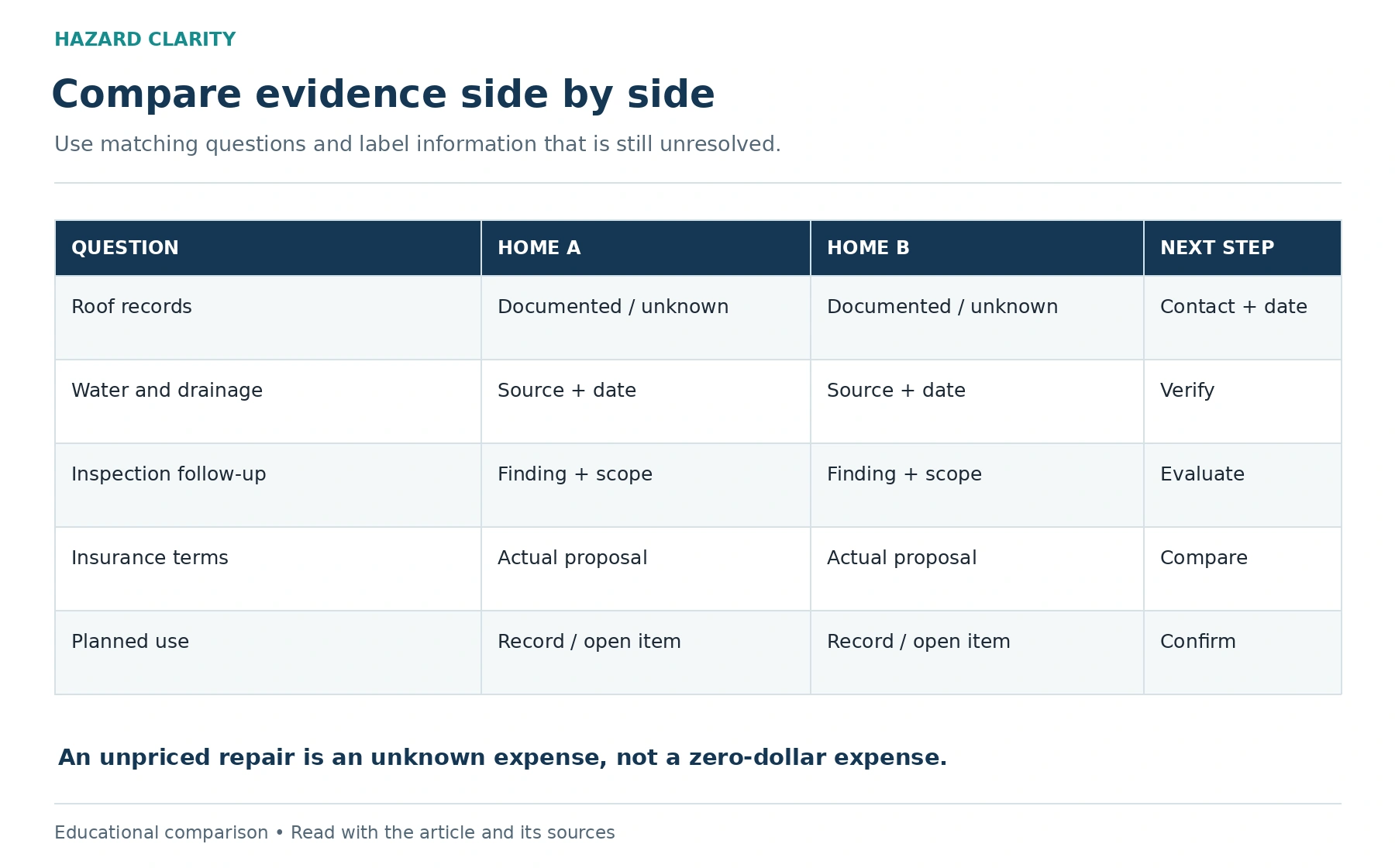
For each row, record the question, the answer for Home A, the answer for Home B, the supporting source, the date, and the next step. Add an evidence status such as documented, reported, estimated, or unresolved. These labels describe what you know rather than whether the property is good or bad.
For example, a seller-provided roof installation invoice may support a documented date. A listing that says “newer roof” may remain a reported description until records clarify it. Put the wording and source in the worksheet so the difference survives beyond your memory of the showing.
Keep a responsible contact and deadline for open questions. A worksheet is more useful when it tells you what action follows the uncertainty. Without that field, it can become a tidy list of concerns that nobody has been assigned to resolve.
Compare location context consistently
Use the same research method for both addresses where possible. Save the sources, dates, geography, and relevant limitations. If the information differs in scope or availability, note that difference rather than treating the outputs as perfectly comparable measurements.
Ask what each item leads you to investigate. A flood map question may require local floodplain records. A wildfire question may lead to site and building preparation records. Weather exposure may lead to roof documentation and insurance review. Location context is most useful when it produces a concrete next question.
Do not label one home safe because no concern appears in a particular source. An absent result may reflect the source’s scope, data availability, or the hazard being investigated. Use an address-based report as one information layer alongside the other property records.
Compare condition using the actual inspection scope
Record who inspected each home, when, and what the service included. A seller’s earlier inspection, your independent inspection, and a specialist assessment may have different purposes and access limitations. Compare their findings with those differences visible.
The Consumer Financial Protection Bureau recommends arranging an independent inspection promptly and attending when possible. Ask the inspector to explain findings and follow-up needs. If you are considering two homes before contracting, ask your real estate professional which services and access can reasonably be arranged at that stage.
Record the physical finding, recommended next step, and available estimate separately. “Further evaluation recommended” is not a completed diagnosis or a confirmed repair price. Keep uncertainty visible until the appropriate professional supplies the missing information.
Compare insurance proposals on matching terms
Request proposals with accurate property information and ask the agent to help align the coverage comparison. Record limits, deductibles, settlement provisions, exclusions, important endorsements, effective dates, and outstanding conditions. A lower premium may accompany materially different terms.
Use HC’s guide to comparing insurance quotes to prepare questions. Ask whether each proposal is complete and whether an inspection or repair could change it. Keep the current version and date rather than copying a price into the worksheet without context.
If separate coverage is proposed for a relevant hazard, record it in its own row. Add its terms and effective date to the comparison. Do not assume a homeowners proposal answers every question about flood, earthquake, or another exposure.
Compare ownership costs beyond the monthly payment
Separate recurring expenses from immediate work and possible future expenses. Use actual estimates, current records, and clearly labeled assumptions. Examples include maintenance, association obligations, insurance, utilities, and work identified during inspections. The relevant items depend on the property and your plans.
Avoid giving a missing estimate a value of zero. An unpriced repair is an unknown expense, not free work. Request a defined scope from the appropriate professional and record whether the amount is a preliminary estimate or a proposal based on property access.
Keep financing and purchase calculations with the people responsible for them. The worksheet can organize inputs, but it should not replace lender disclosures, tax review, legal advice, or a contractor’s scope. Its purpose is to make the evidence easier to compare and discuss.
Include records and intended-use questions
Ask about permits, additions, boundaries, easements, association restrictions, and other records relevant to your use. Keep the exact question with the document or professional response. A general statement that a property has “plenty of room” does not establish permission for your planned project.
If you want to add a pool, expand the house, change access, or use an outbuilding differently, ask the appropriate authority and transaction professional what review is needed. Do not let a visual impression of the lot settle questions about approvals, setbacks, drainage, or utility systems.
Record whether the answer is general guidance or a completed approval. A conversation describing a possible process is different from permission to begin construction. Your decision should reflect the actual status of the intended-use question.
Use a compact worksheet in plain language
Begin with six question rows: roof records, water or drainage questions, inspection follow-up, insurance terms, immediate work, and intended use. For each, fill the two home columns and the evidence status. Add rows for other material issues instead of copying a universal checklist without thinking.
Write answers that someone else can verify. “Looks fine” is difficult to use. “Inspector recommended roof follow-up; appointment requested for Tuesday” identifies the source, unresolved issue, and action. “Seller reports no water entry; no supporting repair records provided” preserves what was actually said.
Review the worksheet with your real estate professional before important deadlines. Ask which open questions affect available choices under your agreement. The worksheet should support those conversations rather than create a parallel process disconnected from the contract.
A hypothetical comparison shows the value
Imagine Home A has a documented recent roof replacement and an unresolved drainage concern. Home B has useful drainage records but an estimated roof age and no current specialist evaluation. Both have similar asking prices and proposed insurance premiums that have not yet been compared on matching terms.
The buyer does not award points for whichever file has more paperwork. Instead, the buyer asks for drainage follow-up on Home A, roof follow-up on Home B, and insurance clarification for both. The next comparison uses the new information, defined estimates, and remaining limitations.
The preferred home may depend on the buyer’s budget, timing, and tolerance for the specific unanswered questions. This example illustrates a decision method; it does not predict hazard losses or prescribe which type of home to purchase.
Avoid false precision in scoring
If you use a personal preference score, keep it separate from hazard facts and technical findings. You can rank how well a layout suits your household. You cannot turn an unresolved structural concern into a scientifically meaningful number merely by assigning it three points.
Use written reasons for major decisions. “We prefer Home A because the planned use is documented and the remaining repair estimate fits our budget” is more informative than an unexplained total. Keep the evidence that supports the reason with the worksheet.
Allow the comparison to change as records arrive. Date each revision and preserve material changes. A good worksheet reflects what is known now; it does not defend the impression you formed on the first tour.
Close the review with an action list
Before deciding, identify the essential questions that are answered, the questions still open, and the actions available within your actual deadlines. Ask the relevant professionals to explain the practical effect of remaining uncertainty. Then assess the property against your use, budget, and priorities.
After purchase, keep the worksheet as a starting point for the ownership file. Transfer recommended maintenance and follow-up into your ongoing plan. Retain the final records, estimates, completed-work invoices, and policies so future decisions do not begin with missing history.
For your next step, choose two addresses and create matching rows for the six core questions. See how Hazard Clarity works to organize location information for both homes, then connect that context with inspections, documents, coverage, and the decisions that matter to you.
Reusable comparison worksheet
Copy this worksheet for two actual properties. Leave unknown fields marked unresolved. This template is outside the article body word count.
Sources and reference material
Consumer Financial Protection Bureau — Schedule a home inspection • Reviewed October 2, 2026
Consumer Financial Protection Bureau — Shop for homeowners insurance • Reviewed October 2, 2026
Sources support the article’s factual foundations; the research workflow, worksheets, and hypothetical examples are original editorial guidance. Confirm current requirements and policy terms for the actual property before relying on a transaction-specific conclusion.
See this property’s own hazard picture.
Check an address